Flux Full Circle
•
6 min
Replacing 9 disconnected tools with one operating platform

Confidentiality notice
Flux OS is Flux Full Circle's proprietary operating platform. Client names and commercially sensitive figures have been generalised.
CHALLENGE
STRATEGY
RESULTS
CHALLENGE
Nine tools, no shared source of truth
Flux OS is an internal and client-facing operating platform that brings marketing data, reporting, service requests and project context into one place.
For five to six years, keeping roughly 40 luxury travel clients informed of their marketing performance meant Account Catalysts manually pulling data out of nine separate tools (GA4, Google Search Console, Google Ads, Meta, LinkedIn, Ahrefs, Mailchimp, HubSpot, and Jira) and synthesising it into a report, every month, for every client. As the portfolio grew, this stopped being a manageable inconvenience and became a scaling problem: monitoring performance across that many disconnected channels created friction for clients and internal teams alike, slowed down every task, and created significant untracked operational overhead.
The deeper issue wasn’t the manual labour. It was that nobody, internally or externally, could see attribution. Internal teams couldn’t easily tell what was and wasn’t working for a given client, let alone why. Clients were stuck with monthly PDFs reporting what had happened, with little context for why performance had changed or what action to take next, right as client expectations were shifting toward continuous visibility and ongoing proof of ROI, not a document that arrived once a month already stale.
Two audiences, one root cause: no shared, continuously updated source of truth connecting marketing activity to its outcomes.
STRATEGY
From UX ownership to product ownership
I joined Flux as the UX designer. I led research, information architecture, interaction design, the design system, UI and prototyping, carrying the product through usability testing and into development. When the platform moved into development, I took on acting product ownership: writing feature specs, shaping the roadmap, and making product decisions alongside engineering.
That continuity mattered. Two of the platform’s hardest problems only surfaced after launch, and because I owned the full stack from research through roadmap, I was able to take both problems from diagnosis through redesign without handing the work off between separate UX and product owners.
Problem 1: An AI feature users didn’t know how to use
Flux had invested heavily in a RAG AI layer, FluxAI, built to let clients and internal teams ask natural-language questions about their data. At launch, it shipped as a standalone item in the main navigation, sitting at the same level as Service Desk and Projects.
That placement created a scope mismatch between expectation and capability. Users reasonably assumed an AI entry point at that level of the navigation could answer questions about anything in the platform. In reality, FluxAI only had access to BigQuery, it could only answer reporting questions. Every question about a ticket or a project timeline hit a dead end. The mismatch made the feature feel unreliable and limited its usefulness.

Before, FluxAI as a standalone nav item / after, contextual reporting panel
I reframed the problem: this wasn’t a discoverability issue to fix with better copy, it was a placement issue. I redesigned FluxAI as a contextual chat panel embedded directly inside the Reporting dashboard, prompted with explicit guidance on what it could help with. Scoping the AI’s presence to its actual capability set clearer expectations before a user ever submitted a question.

A floating FluxAI button, anchoring questions to metrics allows users to query in real-time
Problem 2: A form that produced incomplete briefs
The original Service Desk intake was a structured form. Clients often provided minimal detail, leaving the internal team to chase clarification before work could begin.
I replaced the form with a single natural-language input: a conversational AI-brief flow. A client could type, “Please update the copy on our website.” The system would ask which page and what copy needed changing, requesting only what was missing, rather than demanding a fixed set of fields regardless of relevance.
Ticket submitted → reviewed next day → clarification requested → client responds → reassigned → 3-day turnaround → client review. Every missing detail created another handoff, adding waiting time before the work could even begin.
Before the AI-brief flow, Service Desk tickets took an average of 2.67 days to resolve, with 1.8% explicitly rejected or blocked shortly after submission and under 5% flagged as incomplete briefs. After launch, average resolution time dropped to 1.45 days, a 46% reduction, while the incomplete-brief rate fell to 0%. The redesign also supports Flux’s wider goal of reducing revision rounds through stronger briefing and AI-assisted qualification.
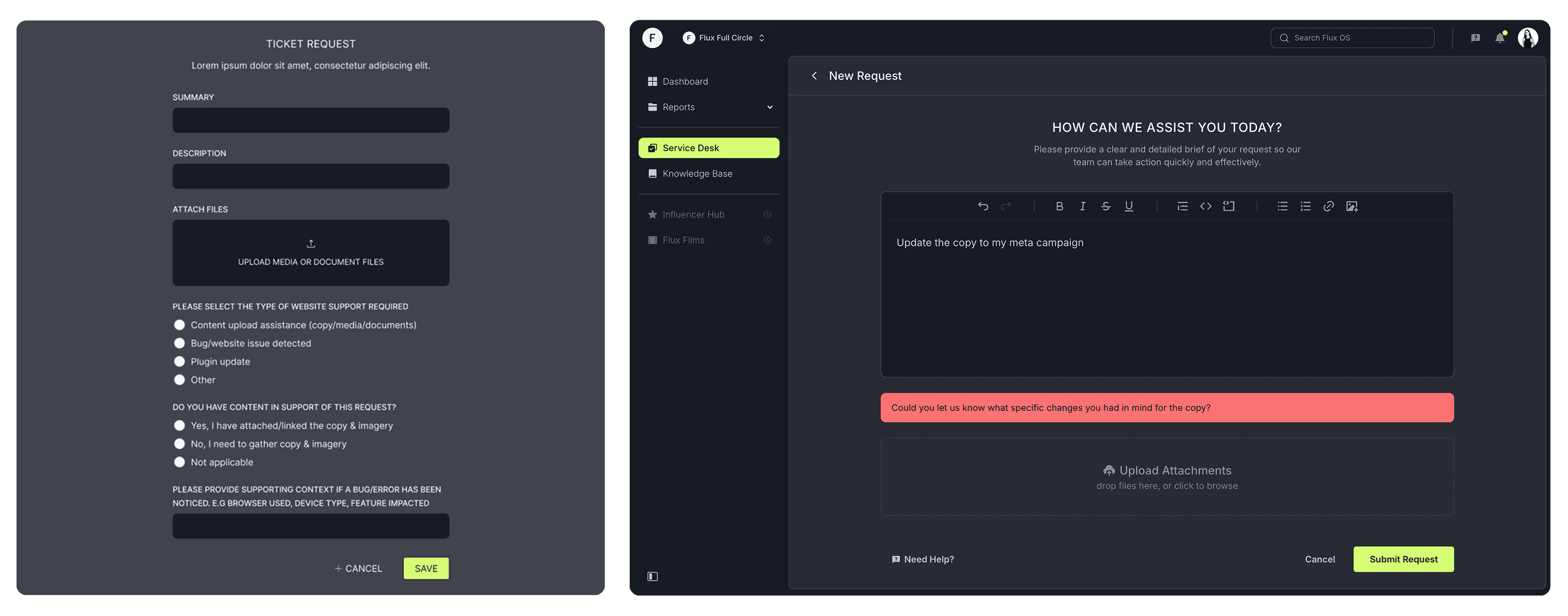
Before, structured ticket form / after, AI-brief conversational flow
The same problem existed internally
The client-facing side wasn’t the only place attribution was missing. Internal specialists (paid media, content, social, SEO, UX) could each see their own channel’s numbers, but had no easy way to see how that connected to the rest of a client’s account, or across the wider portfolio. I extended the same underlying data model into specialist reporting dashboards: real-time views letting a specialist drill from portfolio → product type → client → channel, surfacing the same performance context and drivers available to clients. The real-time view gave specialists earlier visibility into underperformance, rather than waiting for the monthly reporting cycle.

UX dashboard
RESULTS
From monthly reporting to a live system of record
Flux OS is currently in rollout, with 4 client accounts live and the remaining portfolio scheduled for onboarding by the end of September 2026.
TIME
46%
Faster average ticket resolution, from 2.67 to 1.45 days, after the AI-brief redesign
QUALITY
0%
Incomplete-brief rate post-launch, down from under 0.5% pre-launch
ADOPTION
4 / 49
Client accounts: live today / planned by rollout completion
22
Internal team members using the platform
SCALE
9 → 1
Reporting tools consolidated into one system
“Flux OS gave me my time back. I’m not chasing clients to explain what they meant or hunting for metrics across a dozen tabs. I just do strategy now.”
Sarah, Account catalyst
The biggest shift wasn’t consolidating nine tools into one. It was turning fragmented information into something people could actually act on. Taking the product from UX into development also changed how I worked: I wasn’t just designing the interface, I was shaping what the product needed to become.

